Make your public speaking practice count.
Becoming a better speaker doesn’t have to be a huge, time-consuming endeavour. It doesn’t always mean signing up for coaching or applying to be a TEDx speaker.
It can involve each of those efforts, of course, but too often people avoid taking steps to improve their public speaking skills because the process feels overwhelming.
Instead, I want to help you get started in a much more manageable way.
There are several truly simple public speaking skills that, once you get the hang of them, will serve you in almost every speaking situation.
So, whether you’re a leader preparing to deliver a keynote, a business owner looking to show up more confidently on social media, or a professional presenting to a client or leading a team meeting, give me just two minutes and I’ll get you a better outcome the next time you speak, with less effort.
It’s all about choosing the highest-impact actions rather than obsessing about every detail.
Here’s how you’re going to get a solid return on your investment.
01: Breathe More Intentionally
First of all, you’ve gotta breathe!
I see you holding your breath while you’re speaking, just doing your best to get to the end of your presentation, and it’s not doing you any favours.
You already breathe thousands of times a day, and doing it a bit more skillfully and intentionally can make a huge difference to your delivery.
Intentional breathing can help you:
Feel calmer and more present
Manage your pacing
Give your voice more strength and authority
Project your voice more effectively
Reduce filler words. A breath can replace those “ums” and “likes” that can sneak into our speech when we’re trying to figure out what to say or fill an uncomfortable silence.
It also has the handy side benefit of keeping you alive!
Try this:
The next time you’re practicing a presentation, identify a few natural places to pause and take a comfortable breath.
Generally, a breath makes sense when you’ve reached the end of a sentence or completed a thought. Pause, taking a moment before you launch into the next thought. Not only does this give you a chance to breathe, but it also gives your audience time to absorb what you’ve said.
Another tip? Just before you step up to speak, consider having a breathing exercise on hand to calm your nerves. A great option is box breathing, where you breathe in for a count of 4, hold your breath at the top for a count of 4, breathe out for a count of 4, and then hold your breath at the bottom for a count of 4.
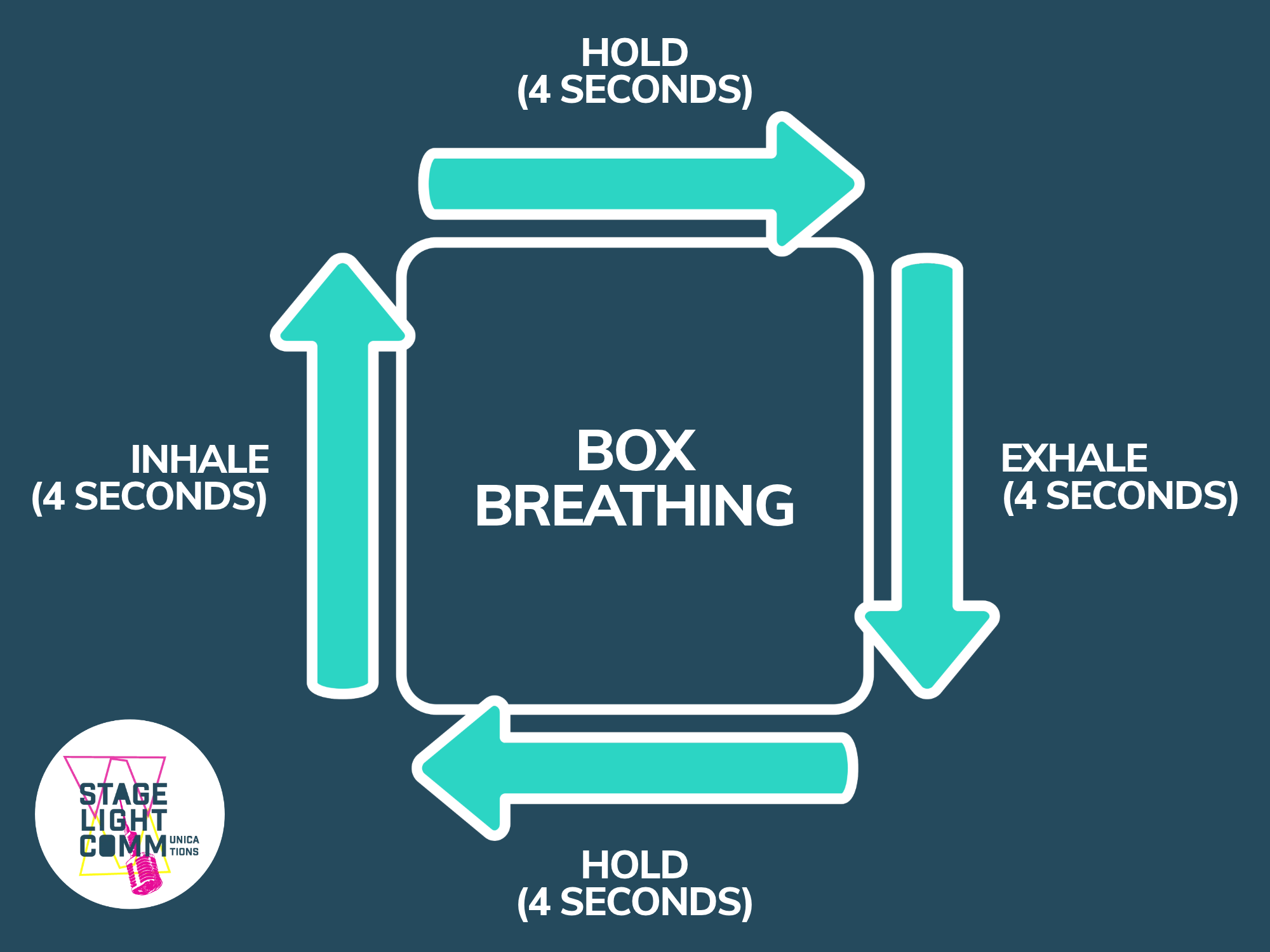
Repeat this a few times, as long as it feels comfortable.
When practicing your breathing, let your stomach and lower ribs gently expand as you breathe in, rather than lifting your shoulders or taking shallow breaths into your upper chest. This can help you relax and release tension.
Looking to learn more? Check out these blogs:
02: Learn the Fundamentals of Vocal Variety
When you make your voice more animated, you instantly become more interesting and easier to understand.
Vocal variety is about making intentional changes to your pitch, pace, volume, and the emphasis you place on certain words.
Subtle variations in your delivery can help your audience:
Stay engaged.
Recognize which parts of your message are most important.
Understand how you feel about what you’re saying.
Remember the key points of your presentation.
Not every word in your presentation needs the same amount of energy. In fact, it’s the contrast in how you deliver different words, sentences, and sections that makes your presentation more interesting.
Once you’ve gotten a handle on some techniques for vocal variety, you can read something you’ve never seen before and still sound polished.
Try this:
Grab your notes for an upcoming presentation or pull a paragraph from a nearby book and read it out loud. Practise putting a bit more emphasis on the action words, emotion words, and the key words you want your audience to remember.
Try reading the same section a few times, experimenting with emphasizing different words, and notice how it changes the meaning behind what you're saying.
Want to learn more? Check out these blogs:
03: Connect With Your Audience
Finally, connecting with your audience is key. Yes, I’m talking about eye contact here, but before you say “pass,” let me explain!
Eye contact doesn’t mean you have to look directly into people’s eyes if that’s uncomfortable for you. It also doesn’t mean maintaining constant eye contact or systematically scanning each person in the room.
It can simply mean looking at faces. When you make an important point, find a friendly face in the audience and let your eyes linger on them for a few seconds. Then move on - glance at your notes, point to something in your presentation, or find another face to connect with.
This can help you get out of your head and remember that you’re communicating with real humans. It can also help your audience feel like you’re speaking to them, rather than at them.
Try this:
Draw a few faces on sticky notes and place them on your wall. As you practise speaking, look at these faces. Keep experimenting with this until it starts to feel more natural!
Want to learn more? Check out these blogs:
Get More Out Of Your Public Speaking
There you go: three high-impact ways to level up your public speaking that won’t take up your whole afternoon.
The great thing about these techniques is that you don’t need an upcoming presentation to start practising them. You can use them in everyday conversations, while contributing to a work meeting, reading a book to your kids, or sharing a story with your friends.
The more you use these techniques in your everyday life, the more naturally they'll come to you when the stakes are higher.
If you’re looking for more practical communication advice like this, subscribe to the Stage Light newsletter to get it delivered straight to your inbox.
And if you'd like some help identifying the highest-impact changes you or your team could make to improve your communication, explore our personalized coaching and corporate communication training services. Together, we'll figure out where your time and energy are best spent.